· ReadyStack
Worked example
Real numbers from this tool, line by line.
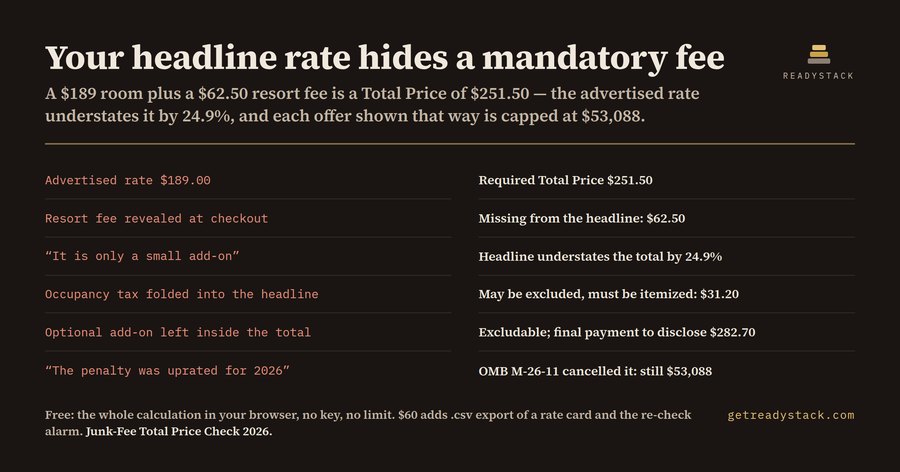
A $189 room with a $62.50 resort fee has a Total Price of $251.50, and the US hotel revenue manager who advertises the $189 is understating it by 24.9% on every offer in the rate card.
That is the FTC's Rule on Unfair or Deceptive Fees, 16 CFR part 464, in force since 12 May 2025. It bans no fee at all. It bans showing a price that is not the total. Section 464.1 defines total price as "the maximum total of all fees or charges a consumer must pay for any good(s) or service(s) and any mandatory ancillary good or service, except that government charges, shipping charges, and fees or charges for any optional ancillary good or service may be excluded." Section 464.2 then requires that total price be displayed "more prominently than any other pricing information", and that the nature, purpose and amount of every excluded charge be disclosed before the customer is asked to pay.
Two categories are covered and no others: live-event tickets, and short-term lodging, which 464.1 spells out as "temporary sleeping accommodations at a hotel, motel, inn, short-term rental, vacation rental, or other place of lodging." Sell something else and the federal rule does not reach your offer, and the extension says so rather than inventing an exposure number.
The part assistants get wrong is the price of being wrong. A knowing violation of a trade regulation rule carries a civil penalty under section 5(m)(1)(A) of the FTC Act, and 16 CFR 1.98(d) sets that maximum at $53,088. Every previous year it rose with inflation, so a chatbot asked for the current number uprates it. It did not rise. On 17 April 2026, OMB issued memorandum M-26-11, which states that because the government shutdown stopped the Bureau of Labor Statistics producing October 2025 CPI-U data, "there will be no updated cost-of-living adjustment multiplier for 2026 and agencies will continue using the 2025 civil monetary penalty levels as applicable." The ceiling is still $53,088 per violation. Put an uprated figure in a board memo and the memo is wrong.
The second mistake runs the other way and costs you bookings. Government charges may be excluded: occupancy tax does not belong inside the headline number, nor does shipping on a mailed ticket, nor an optional add-on the guest can decline. Fold it all in and you publish a rate higher than the rule requires, and lose the search-results comparison to the property next door.
The extension takes ten values and answers as you type. On the sample offer above, with $25 of optional add-ons, $31.20 of occupancy tax and forty rate-plan combinations displayed the same way: required Total Price $251.50, missing from the headline $62.50, understated by 24.9%, excluded charges to itemize $31.20, final amount of payment $282.70, $307.70 if every add-on is taken, forty offers that would each be a separate violation, and a statutory maximum of $2,123,520. Switch the category to something outside 464.1 and the violation count drops to zero while the arithmetic stays.
Enforcement is real: the FTC filed its first case under the rule, FTC v. StubHub, on 9 April 2026 in the Southern District of New York.
All of the above is free, in the popup and in one web page running the same code, with no key, no watermark and no cap on how many offers you check. The $60 licence adds two things on a different axis: the rate card leaves the browser as a .csv with a Total Price column, and an alarm brings you back on the date the next federal penalty adjustment publishes. For scale, DOJ's Fitzpatrick Matrix puts a 15-year attorney at $851 an hour for billing year 2026.
Questions people ask
What does this extension actually do?
You type the advertised rate, the mandatory fees, the optional add-ons, the government charges and shipping. It returns the Total Price that 16 CFR 464.1 requires you to display, the dollar amount your headline rate is hiding, the share it understates, the charges you may exclude but must still itemize before payment, and the statutory penalty ceiling of $53,088 per violation.
Who is it for?
Revenue managers and e-commerce leads at US hotels, motels, inns and vacation rentals, hosts who list on their own booking pages, and live-event ticket sellers. Those two categories are the only covered goods or services in 16 CFR 464.1, and the extension says so when you pick anything else.
Why is a chatbot not enough?
Ask any assistant for the 2026 FTC penalty maximum and it will uprate the 2025 figure, because every previous year had an inflation adjustment. OMB memo M-26-11 of April 17, 2026 cancelled the 2026 adjustment for lack of October 2025 CPI-U data, so the ceiling is still $53,088. The tool holds that constant.
What is free and what costs money?
Every calculation is free, in the popup and in the free web page, with no key, no watermark and no limit on how many offers you check. The $60 licence key adds two things on a different axis: exporting a whole rate card to a .csv file that leaves the browser with you, and a browser alarm that reminds you to re-check the penalty figure.
What would this cost with a lawyer?
DOJ's Fitzpatrick Matrix, the official hourly rate table for complex federal litigation in the District of Columbia, puts a 15-year attorney at $851 an hour for billing year 2026 and a paralegal at $273. One hour of either costs more than the licence, and a rate card has dozens of offers to check.
Ask about this tool
One question, answered by the person who built it. Your email only if you want the answer sent.